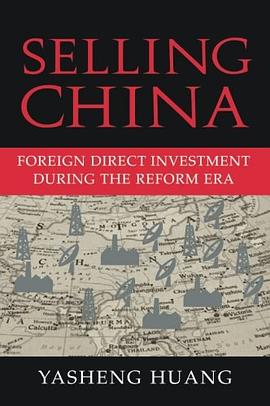
Selling China
内容简介
In this book, Yasheng Huang makes a provocative claim: the large absorption of foreign direct investment (FDI) by China is a sign of some substantial weaknesses in the Chinese economy. The primary benefits associated with China's FDI inflows are concerned with the privatization functions supplied by foreign firms, venture capital provisions to credit-constrained private entrepreneurs, and promotion of interregional capital mobility. Huang argues that one should ask why domestic firms cannot supply the same functions. China's partial reforms, while successful in increasing the scope of the market, have so far failed to address many allocative inefficiencies in the Chinese economy.
......(更多)
作者简介
Yasheng Huang, Massachusetts Institute of Technology
Yasheng Huang is Associate Professor at the Sloan School of Management, Massachusetts Institute of Technology. He formerly taught at the Harvard Business School. Professor Huang is also the author of Inflation and Investment Controls in China (Cambridge, 1996). He is a recipient of the Social Science Research Council - McArthur Foundation Fellowship.
Read more at
......(更多)
目录
List of tables and figures
List of abbreviations
Synopsis of the book
Preface
1. Introduction
2. An analytical framework
3. Problems in China's corporate sector
4. Constraints on nonstate firms and foreign direct investment
5. State-owned enterprises and insolvency-induced foreign direct investment
6. Economic fragmentation and foreign direct investment
7. Conclusion
Bibliography
Index.
Read more at
......(更多)
读书文摘
本书提出了一个猜想:迄今为止中国的改革策略的动机是挽救社会主义而不是终止社会主义。局部改革——尽管成功地增大了市场范围,但是,至今还不能——将来似乎也不能——解决中国经济的某些基础性的无效率问题。在处理这些无效率问题上,就需要实现私有产权的安全,并对私有产权做出更进一步的承诺。这一个意义深远的政治选择,是中国迟早必将正视的选择。
......(更多)