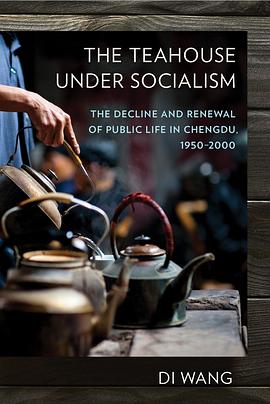
The Teahouse under Socialism
内容简介
To understand a city fully, writes Di Wang, we must observe its most basic units of social life. In The Teahouse under Socialism, Wang does just that, arguing that the teahouses of Chengdu, the capital of Sichuan Province, are some of the most important public spaces―perfect sites for examining the social and economic activities of everyday Chinese.
Wang looks at the transformation of these teahouses from private businesses to collective ownership and how state policy and the proprietors’ response to it changed the overall economic and social structure of the city. He uses this transformation to illuminate broader trends in China’s urban public life from 1950 through the end of the Cultural Revolution and into the post-Mao reform era. In doing so, The Teahouse under Socialism charts the fluctuations in fortune of this ancient cultural institution and analyzes how it survived, and even thrived, under bleak conditions.
Throughout, Wang asks such questions as: Why and how did state power intervene in the operation of small businesses? How was "socialist entertainment" established in a local society? How did the well-known waves of political contestation and struggle in China change Chengdu’s teahouses and public life? In the end, Wang argues, the answers to such questions enhance our understanding of public life and political culture in the Communist state.
......(更多)
作者简介
Di Wang is Distinguished Professor and Head of the Department of History, University of Macau. Among his many books are The Teahouse: Small Business, Everyday Culture, and Public Politics in Chengdu, 1900-1950 and Street Culture in Chengdu: Public Space, Urban Commoners, and Local Politics, 1870-1930.
......(更多)
目录
......(更多)
读书文摘
本书通过考察20世纪下半叶的成都茶馆,试图回答如下问题:国家权力怎样介入小商业的经营之中?社会主义娱乐是怎样在地方社会中建立起来的?传统行会发生了怎样的变化,最后怎样走向死亡?政治运动怎样改变了茶馆和公共生活?在改革开放时期,茶馆是如何走向复兴的?公共生活是怎样影响城市形象,国家和人民又是如何看待这一问题的?等等。
......(更多)