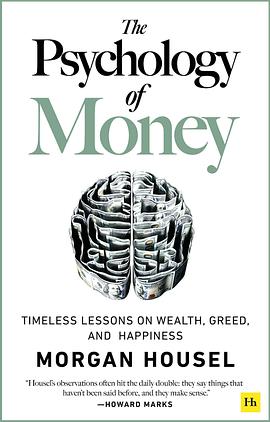
The Psychology of Money
内容简介
Doing well with money isn’t necessarily about what you know. It’s about how you behave. And behavior is hard to teach, even to really smart people.
Money―investing, personal finance, and business decisions―is typically taught as a math-based field, where data and formulas tell us exactly what to do. But in the real world people don’t make financial decisions on a spreadsheet. They make them at the dinner table, or in a meeting room, where personal history, your own unique view of the world, ego, pride, marketing, and odd incentives are scrambled together.
In The Psychology of Money, award-winning author Morgan Housel shares 19 short stories exploring the strange ways people think about money and teaches you how to make better sense of one of life’s most important topics.
......(更多)
作者简介
Morgan Housel is a partner at The Collaborative Fund and a former columnist at The Motley Fool and The Wall Street Journal. He is a two-time winner of the Best in Business Award from the Society of American Business Editors and Writers, winner of the New York Times Sidney Award, and a two-time finalist for the Gerald Loeb Award for Distinguished Business and Financial Journalism.
......(更多)
目录
......(更多)
读书文摘
维持一种低于经济能力的生活方式的附加好处是,这会防止你产生攀比心理。在你负担得起的范围内舒适地生活,不产生过多欲望,你会避免现代西方世界中许多人要承受的巨大社会压力。纳西姆·塔勒布解释道:“退出无谓的激烈竞争,以获得内心平静为目标来调节你的行为,才是真正的成功。”
......(更多)