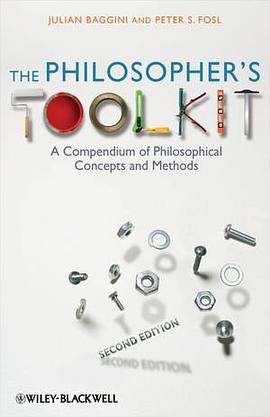
The Philosopher's Toolkit
内容简介
The second edition of this popular compendium provides the necessary intellectual equipment to engage with and participate in effective philosophical argument, reading, and reflection Features significantly revised, updated and expanded entries, and an entirely new section drawn from methods in the history of philosophy This edition has a broad, pluralistic approach--appealing to readers in both continental philosophy and the history of philosophy, as well as analytic philosophy Explains difficult concepts in an easily accessible manner, and addresses the use and application of these concepts Proven useful to philosophy students at both beginning and advanced levels
......(更多)
作者简介
朱利安• 巴吉尼
● 《哲学家杂志》共同创办人、主编,英国知名哲学普及畅销图书作家。
● 哲学博士,定期为《卫报》《独立报》《泰晤士报》《金融时报》《新政治家》等报刊撰稿,并且固定在英国广播公司第四电台上发声。
● 《卫报》称:“他拥有一颗清明的心智,这让他在哲学普及书籍的领域中格外杰出。” 他的书总是能切中当代人的思想和伦理困惑,以生动的故事或语言作为思想实验场景,为人们提供多种哲学选择的可能性。他的书总是能打破传统的思维框架,另辟险峰。
彼得•福斯
● 美国特兰西瓦尼亚大学哲学系杰出教授。
● 常为《哲学家杂志》撰稿,与朱利安•巴吉尼曾合著过《伦理学工具箱》(The Ethics Toolkit),另著有《英国哲学家》(British Philosophers)。
● 研究领域涉及怀疑主义、伦理学、宗教哲学及哲学史等。
......(更多)
目录
Preface.
Acknowledgements.
1. Basic Tools for Argument.
1.1 Arguments, premises and conclusions.
1.2 Deduction.
1.3 Induction.
1.4 Validity and soundness.
1.5 Invalidity.
1.6 Consistency.
1.7 Fallacies.
1.8 Refutation.
1.9 Axioms.
1.10 Definitions.
1.11 Certainty and probability.
1.12 Tautologies, self-contradictions and the law of non-contradiction.
2. More Advanced Tools.
2.1 Abduction.
2.2 Hypothetico-deductive method.
2.3 Dialectic.
2.4 Analogies.
2.5 Anomalies and exceptions that prove the rule.
2.6 Intuition pumps.
2.7 Logical constructions.
2.8 Reduction.
2.9 Thought experiments.
2.10 Useful fictions.
3. Tools for Assessment.
3.1 Alternative explanations.
3.2 Ambiguity.
3.3 Bivalence and the excluded middle.
3.4 Category mistakes.
3.5 Ceteris paribus.
3.6 Circularity.
3.7 Conceptual incoherence.
3.8 Counterexamples.
3.9 Criteria.
3.10 Error theory.
3.11 False dichotomy.
3.12 False cause.
3.13 Genetic fallacy.
3.14 Horned dilemmas.
3.15 Is/ought gap.
3.16 Masked man fallacy.
3.17 Partners in guilt.
3.18 Principle of charity.
3.19 Question-begging.
3.20 Reductios.
3.21 Redundancy.
3.22 Regresses.
3.23 Saving the phenomena.
3.24 Self-defeating arguments.
3.25 Sufficient reason.
3.26 Testability.
4. Tools for Conceptual Distinctions.
4.1 A priori/a posteriori.
4.2 Absolute/relative.
4.3 Analytic/synthetic
4.4 Categorical/modal.
4.5 Conditional/biconditional.
4.6 De re/de dicto.
4.7 Defeasible/indefeasible.
4.8 Entailment/implication.
4.9 Essence/accident.
4.10 Internalism/externalism.
4.11 Knowledge by acquaintance/description.
4.12 Necessary/contingent.
4.13 Necessary/sufficient.
4.14 Objective/subjective.
4.15 Realist/non-realist.
4.16 Sense/reference.
4.17 Syntax/semantics.
4.18 Thick/thin concepts.
4.19 Types/tokens.
5. Tools of Historical Schools and Philosophers.
5.1 Aphorism, fragment, remark.
5.2 Categories and specific differences.
5.3 Elenchus and aporia.
5.4 Hume's fork.
5.5 Indirect discourse.
5.6 Leibniz's law of identity.
5.7 Ockham's razor.
5.8 Phenomenological method(s).
5.9 Signs and signifiers.
5.10 Transcendental argument.
6. Tools for Radical Critique.
6.1 Class critique.
6.2 Deconstruction and the critique of presence.
6.3 Empiricist critique of metaphysics.
6.4 Feminist critique.
6.5 Foucaultian critique of power.
6.6 Heideggerian critique of metaphysics.
6.7 Lacanian critique.
6.8 Critiques of naturalism.
6.9 Nietzschean critique of Christian-Platonic culture.
6.10 Pragmatist critique.
6.11 Sartrean critique of 'bad faith'.
7. Tools at the Limit.
7.1 Basic beliefs.
7.2 Gödel and incompleteness.
7.3 Philosophy and/as art.
7.4 Mystical experience and revelation.
7.5 Paradoxes.
7.6 Possibility and impossibility.
7.7 Primitives.
7.8 Self-evident truths.
7.9 Scepticism.
7.10 Underdetermination.
Internet Resources for Philosophers.
Index.
......(更多)
读书文摘
事物多具有两面性,哲学对概念的划分方法亦是两两相对。清晰地区分辩论双方各自所持的观点,有助于我们辩证地思考事物的本质属性、形式与范畴、发展逻辑关系,对认识人类的思想意志、行为动机,构建社会伦理道德及完善日常语言逻辑也大有脾益。
......(更多)