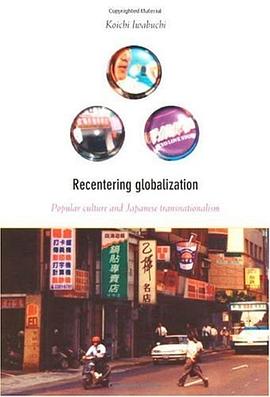
Recentering Globalization
内容简介
Globalization is usually thought of as the worldwide spread of Western - particularly American - popular culture. Yet, if one nation stands out in the dissemination of pop culture in East and Southeast Asia, it is Japan. Pokemon, anime, pop music, television dramas such as "Tokyo Love Story" and "Long Vacation" - the export of Japanese media and culture is big business. In "Recentering Globalization", Koichi Iwabuchi explores how Japanese popular culture circulates in Asia. He situates the rise of Japan's cultural power in light of decentering globalization processes and demonstrates how Japan's extensive cultural interactions with the other parts of Asia complicate its sense of being "in but above" or "similar but superior to" the region.Iwabuchi has conducted extensive interviews with producers, promoters, and consumers of popular culture in Japan and East Asia. Drawing upon this research, he analyzes Japan's "localizing" strategy of repackaging Western pop culture for Asian consumption and the ways Japanese popular culture arouses regional cultural resonances. He considers how transnational cultural flows are experienced differently in various geographic areas by looking at bilateral cultural flows in East Asia. He shows how Japanese popular music and television dramas are promoted and understood in Taiwan, Hong Kong, and Singapore, and how "Asian" (especially Hong Kong's) popular culture is received in Japan. Rich in empirical detail and theoretical insight, "Recentering Globalization" is a significant contribution to thinking about cultural globalization and transnationalism, particularly in the context of East Asian cultural studies.
......(更多)
作者简介
Koichi Iwabuchi is Professor of Media and Cultural Studies at Waseda University in Tokyo. For many years he was a reporter and producer for Nippon Television Network Corporation (ntv).
......(更多)
目录
Acknowledgments
Note on Japanese Names
Introduction: The 1990s—Japan returns to Asia in the age of globalization
1. Taking “Japanization” seriously: Cultural globalization reconsidered
2. Trans/nationalism: The discourse on Japan in the global cultural flow
3. Localizing “Japan” in the booming Asian markets
4. Becoming culturally proximate: Japanese TV dramas in Taiwan
5. Popular Asianism in Japan: Nostalgia for (different) Asian modernity
6. Japan’s Asian dreamworld
Notes
References
Index
......(更多)
读书文摘
......(更多)