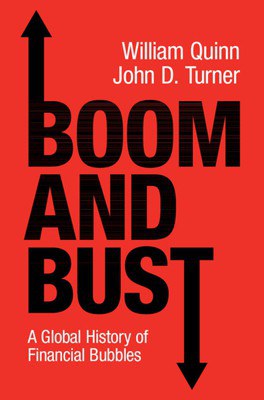
Boom and Bust
内容简介
Why do stock and housing markets sometimes experience amazing booms followed by massive busts and why is this happening more and more frequently? In order to answer these questions, William Quinn and John D. Turner take us on a riveting ride through the history of financial bubbles, visiting, among other places, Paris and London in 1720, Latin America in the 1820s, Melbourne in the 1880s, New York in the 1920s, Tokyo in the 1980s, Silicon Valley in the 1990s and Shanghai in the 2000s. As they do so, they help us understand why bubbles happen, and why some have catastrophic economic, social and political consequences whilst others have actually benefited society. They reveal that bubbles start when investors and speculators react to new technology or political initiatives, showing that our ability to predict future bubbles will ultimately come down to being able to predict these sparks.
......(更多)
作者简介
John Turner grew up in a small town in County Tyrone, which had the dubious honour of being Europe's unemployment black spot in the 1970s and 80s. This ignited his interest in all things economic at very young age. John is currently Professor of Finance and Financial History at Queen’s University Belfast. He is also the founder and director of the Queen’s University Centre for Economic History. John's research focuses on the long-run evolution and development of banking, banking crises, bubbles, corporate law, and financial markets. He also writes a blog for his students (www.financelongrun.co.uk), which looks at the past, present, and future of finance. John has held several distinguished visiting positions during his career - he has been a Houblon-Norman Fellow at the Bank of England and an Alfred D. Chandler Fellow at Harvard Business School.
......(更多)
目录
......(更多)
读书文摘
......(更多)