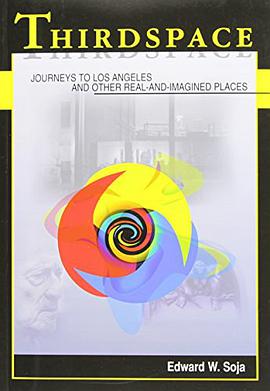
Thirdspace
内容简介
Contemporary critical studies have recently experienced a significant spatial turn. In what may eventually be seen as one of the most important intellectual and political developments in the late twentieth century, scholars have begun to interpret space and the embracing spatiality of human life with the same critical insight and emphasis that has traditionally been given to time and history on the one hand, and social relations and society on the other. Thirdspace is both an enquiry into the origins and impact of the spatial turn and an attempt to expand the scope and practical relevance of how we think about space and such related concepts as place, location, landscape, architecture, environment, home, city, region, territory, and geography. The book's central argument is that spatial thinking, or what has been called the geographical or spatial imagination, has tended to be bicameral, or confined to two approaches. Spatiality is either seen as concrete material forms to be mapped, analyzed, and explained; or as mental constructs, ideas about and representations of space and its social significance. Edward Soja critically re-evaluates this dualism to create an alternative approach, one that comprehends both the material and mental dimensions of spatiality but also extends beyond them to new and different modes of spatial thinking. Thirdspace is composed as a sequence of intellectual and empirical journeys, beginning with a spatial biography of Henri Lefebvre and his adventurous conceptualization of social space as simultaneously perceived, conceived, and lived. The author draws on Lefebvre to describe a trialectics of spatiality that threads though all subsequent journeys, reappearing in many new forms in bell hooks evocative exploration of the margins as a space of radical openness; in post-modern spatial feminist interpretations of the interplay of race, class, and gender; in the postcolonial critique and the new cultural politics of difference and identity; in Michel Foucault's heterotopologies and trialectics of space, knowledge, and power; and in interpretative tours of the Citadel of downtown Los Angeles, the Exopolis of Orange County, and the Centrum of Amsterdam.
......(更多)
作者简介
......(更多)
目录
......(更多)
读书文摘
我们之中大多数人是同时既在内部又在外部。任何外部的错位怀旧,抑或将外部浪漫化作激进反叛的一个特权场所,都马上将我们引入歧途。因为为了实现外部,我们必须至少是在一定程度上,舒舒服服先已待在了内部。当我们说话的地点很近中心的时候,我们确实只有闲暇来理想化边缘力量的颠覆潜能。
......(更多)