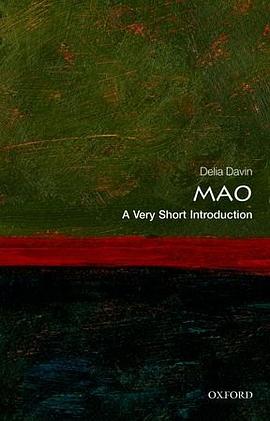
Mao
内容简介
Ideal for anyone wishing to know more about one of the most defining figures of the 20th century Asian history
Fascinating story of Mao's life - from his childhood to his time as leader of China
Considers Mao the man as well as Mao the leader - exploring the major events in his life and his revolutionary writings
Examines the events that led to the Cultural Revolution and its historical impact
Part of the bestselling Very Short Introductions series - over five million copies sold worldwide
As a giant of 20th century history, Mao Zedong played many roles: peasant revolutionary, patriotic leader against the Japanese occupation, Marxist theoretician, modernizer, and visionary despot. This Very Short Introduction chronicles Mao's journey from peasant child to ruler of the most populous nation on Earth. He was a founder of both the Chinese Communist Party and the Red Army, and for many years he fought on two fronts, for control of the Party and in an armed struggle for the Party's control of the country. His revolution unified China and began its rise to world power status. He was the architect of the Great Leap Forward that he hoped would make China both prosperous and egalitarian, but instead ended in economic disaster resulting in millions of deaths. It was Mao's growing suspicion of his fellow leaders that led him to launch the Cultural Revolution, and his last years were dogged by ill-health and his despairing attempts to find a successor whom he trusted.
Delia Davin provides an invaluable introduction to Mao, showing him in all his complexity; ruthless, brutal, and ambitious, a man of enormous talent and perception, yet a leader who is still detested by some and venerated by others.
......(更多)
作者简介
Delia Davin, Emeritus Professor of Chinese Studies, University of Leeds
Delia Davin taught at Leeds University from 1988 until her retirement in 2004, where she is now emeritus professor of Chinese Studies. Her research interests were focussed on women and gender issues in China and she is the author of Womanwork, Women and the Party in Revolutionary China (OUP, 1976). She wrote some of the earliest studies of the single child policy in China and with other colleagues she translated and edited Chinese Lives, an oral history of contemporary China (Penguin, 1989). Her abiding interest in Mao Zedong and the history of Maoist China was inspired by her experience of living in Beijing.
......(更多)
目录
1: Formative years
2: Marxist Labour organizer to Peasant Revolutionary
3: Achieving pre-eminence 1934-1949
4: The revolution institutionalized: first years of the People's Republic
5: The Great Leap Forward and its Aftershocks
6: The Cultural Revolution
7: Decline and death
8: Assessments and legacies
References and further reading
......(更多)
读书文摘
毛泽东对惊讶的代表们说:“我问我身边的同志:我们是住在天上,还是住在地上?他们摇摇头,说是住在地上。”毛泽东以猴的精明持不同看法,“我说不,我们是住在天上。如果别的星球有人,他们看我们不是也是住在天上吗?所以,我说,我们是住在地上,同时又是住在天上。
毛泽东坚信过去的美景可以再现于未来,这激起了他最初的政治雄心。他的独特兴趣在于历史是如何演进的。他认为理想和非凡人物的坚强意志是历史的关键所在。
......(更多)