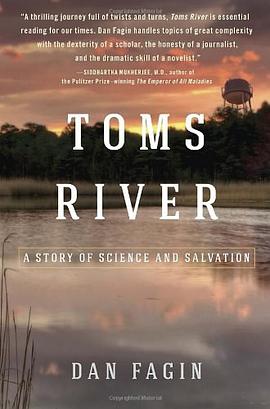
Toms River
内容简介
The riveting true story of a small town ravaged by industrial pollution, Toms River melds hard-hitting investigative reporting, a fascinating scientific detective story, and an unforgettable cast of characters into a sweeping narrative in the tradition of A Civil Action, The Emperor of All Maladies, and The Immortal Life of Henrietta Lacks.
One of New Jersey’s seemingly innumerable quiet seaside towns, Toms River became the unlikely setting for a decades-long drama that culminated in 2001 with one of the largest legal settlements in the annals of toxic dumping. A town that would rather have been known for its Little League World Series champions ended up making history for an entirely different reason: a notorious cluster of childhood cancers scientifically linked to local air and water pollution. For years, large chemical companies had been using Toms River as their private dumping ground, burying tens of thousands of leaky drums in open pits and discharging billions of gallons of acid-laced wastewater into the town’s namesake river.
In an astonishing feat of investigative reporting, prize-winning journalist Dan Fagin recounts the sixty-year saga of rampant pollution and inadequate oversight that made Toms River a cautionary example for fast-growing industrial towns from South Jersey to South China. He tells the stories of the pioneering scientists and physicians who first identified pollutants as a cause of cancer, and brings to life the everyday heroes in Toms River who struggled for justice: a young boy whose cherubic smile belied the fast-growing tumors that had decimated his body from birth; a nurse who fought to bring the alarming incidence of childhood cancers to the attention of authorities who didn’t want to listen; and a mother whose love for her stricken child transformed her into a tenacious advocate for change.
A gripping human drama rooted in a centuries-old scientific quest, Toms River is a tale of dumpers at midnight and deceptions in broad daylight, of corporate avarice and government neglect, and of a few brave individuals who refused to keep silent until the truth was exposed.
......(更多)
作者简介
Dan Fagin is an associate professor of journalism and the director of the Science, Health, and Environmental Reporting Program at New York University’s Arthur L. Carter Journalism Institute. For fifteen years, he was the environmental writer at Newsday, where he was twice a principal member of reporting teams that were finalists for the Pulitzer Prize. His articles on cancer epidemiology were recognized with the Science Journalism Award of the American Association for the Advancement of Science and the Science in Society Award of the National Association of Science Writers.
......(更多)
目录
......(更多)
读书文摘
调解胜于对抗,和解强于胜诉。民法系统的根基——可以通过战胜他人来解决自身的问题并令自己快乐——是一个谎言。从说出‘我要运用法律武器将我的意志强加于你’这一刻起,人们已经相信了这个谎言。法律会令你失望,它只为它自身存在。真相也不属于任何一方。但受害者往往确信他们了解真相。他们想要的是证据和确认,可这些东西是无法从法律体系获得的。
在汤姆斯河事件中——从发现儿童癌症集群,到决定进行调查,再到现在识别出可疑原因——没有一件事是由持续、主动的政府监管提前确定的。恰恰相反,是恰当仪器在恰当的时间用在了恰当操作者手里,这一系列的幸运发现了TIC。现在,它究竟是什么,就要被恰当的人揭晓了。
......(更多)