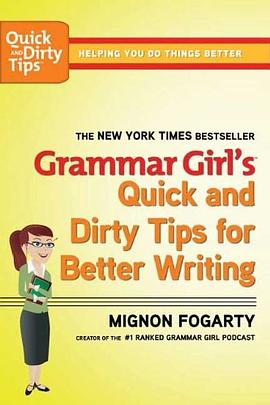
Grammar Girl's Quick and Dirty Tips for Better Writing
内容简介
Are you a fool for mnemonics? If so, you'll fall head over nubucks for Mignon Fogarty--a.k.a. the Grammar Girl--and her handy new audio guide to writing and speaking well. It’s chock-full of smart little anecdotes and memory tricks for felling the most common grammatical foes (who can ever remember the difference between "nauseous" and "nauseated" anyway?) and at just an hour long it's the perfect turn-to resource for students and professionals alike. I didn't try too hard to stump Grammar Girl in our Q&A, but with her eagle eyes she spotted my grammatical (typographical?) misstep without missing a beat! --Anne Bartholomew
Questions for the Grammar Girl
Amazon.com: Now that we communicate so often via e-mail and text messaging, do you think that people have become more desensitized to poor grammar, or in your experience is awareness more heightened as a result?
Grammar Girl: The average person seems to have become more desensitized to poor grammar, but language lovers seem to be tormented by the flood of mutilated e-mail and text messages—at least a lot of the people I hear from seem to be tormented. It might be a self-selecting group. To use one of my father's favorite phrases, language lovers seem to feel as though they are "being pecked to death by a duck."
Amazon.com: Your weekly podcast helps millions of listeners use good grammar and write more effectively. Do you think there is more value in learning by listening, as compared to reading and practical exercise?
Grammar Girl: Perhaps it's ironic, but I have a hard time learning by just listening. I need to read things, which is one of the reasons why I provide full transcripts for all my audio podcasts on the Grammar Girl Web site. People learn in different ways, so those who want to listen can listen, and those who want to read can read. In my experience, nothing beats practical exercise. I often have to look up grammar rules over and over again because I can't remember them, but once I've written a show about a rule, I always remember it.
Amazon.com: Have the grammar mnemonics you've developed come easily to you? Which ones were the toughest to capture in an easy-to-remember tip?
Grammar Girl: Some mnemonics come easily and some don't. I had a hard time coming up with a way for people to remember the difference between "its" and "it's," and I ended up using a really complicated story about a dream I had involving the eBay "it" advertising campaign. I think the best mnemonics are the simple ones. Remembering that you should say "different from" instead of "different than" because "different" has two f's and "from" starts with an f isn't awfully creative, but it's easy to remember.
Amazon.com: Is there a grammar rule that even Grammar Girl finds hard to remember?
Grammar Girl: There are so many that it's hard to pick just one! I have a notoriously terrible memory, which is why I'm always making up mnemonics.
Often I find that when I can't remember something it's because it is a style issue instead of a hard-and-fast rule, so different people do it differently and there is no "right" answer. For example, I always have to look up the rules about whether the verb should be singular or plural after collective nouns like "team" and phrases like "the couple" and "one of the people who."
But when I look up the rule for collective nouns, I am reminded that the "rule" is that you have to just decide whether your collective noun has a sense of being a group or a sense of being many individuals. (And then there are also differences between British and American English.)
It's even worse with a phrase like "one of the people who": experts are split over whether the verb should be singular or plural. There really isn't an answer; you just have to pick a side. I have a hard time making a mnemonic for something like that!
Amazon.com: It used to be that proper grammar and thoughtful wording were the defining factors of a good piece of writing. Increasingly, however, writing is prized for the speed with which it is produced and not necessarily the craft. How can conscientious writers find the happy medium between form and efficiency?
Grammar Girl: What, didn't I answer your questions fast enough?
But seriously, I don't think I've come in contact with the people who value speed. As a Web editor, I certainly wasn't happy when people turned in bad writing, even if they turned it in early. And when I was writing magazine articles or corporate materials for a living I never felt rushed (except when I waited too long to get started).
The places where I do feel a sense of urgency are in e-mail and messaging; people seem to expect immediate responses. But writing a high-quality message doesn't take much more time than writing a careless message; it just takes more focus.
Amazon.com: Bonus question: I wrote all these questions with no more than a cursory grammar and spelling check. How did I do?
Grammar Girl: I found only one major error, and I changed the text to bold. It looked like a typo rather than an error in your understanding of the rules. Good job!
......(更多)
作者简介
蜜妮安•福格蒂(Mignon Fogarty) 网名“语法女王”(Grammar Girl),大学毕业于西雅图华盛顿大学(the University o Washington in Seattle)的英文系,并取得了斯坦福大学(Stanford University)生物学硕士。她创造了全美最受欢迎的英文学习网站——www.quickanddirtytips.com。除了自己创业与专门从事科技写作,她还是美国许多健康与科学网站的编辑与规划者。目前,她和丈夫派崔克(Patrick)一起住在内华达的雷诺市(Reno, Nevada)。 2006年夏天,她下定决心要改善大家的糟糕语法,于是开始将语法秘诀制作成广播节目,每周定期通过iPod的播客网放送,纠正人们在言谈中最常见的错误。她的网站内容至今被下载1亿3000万次,因而受邀参加欧普拉脱口秀,并在节目中大秀语法秘诀。对此,《纽约时报》及《华尔街日报》有专门的文章报道。
......(更多)
目录
......(更多)
读书文摘
......(更多)