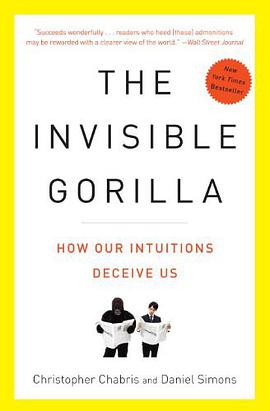
The Invisible Gorilla
内容简介
Reading this book will make you less sure of yourself—and that’s a good thing. In The Invisible Gorilla, Christopher Chabris and Daniel Simons, creators of one of psychology’s most famous experiments, use remarkable stories and counterintuitive scientific findings to demonstrate an important truth: Our minds don’t work the way we think they do. We think we see ourselves and the world as they really are, but we’re actually missing a whole lot.
Chabris and Simons combine the work of other researchers with their own findings on attention, perception, memory, and reasoning to reveal how faulty intuitions often get us into trouble. In the process, they explain:
• Why a company would spend billions to launch a product that its own analysts know will fail
• How a police officer could run right past a brutal assault without seeing it
• Why award-winning movies are full of editing mistakes
• What criminals have in common with chess masters
• Why measles and other childhood diseases are making a comeback
• Why money managers could learn a lot from weather forecasters
Again and again, we think we experience and understand the world as it is, but our thoughts are beset by everyday illusions. We write traffic laws and build criminal cases on the assumption that people will notice when something unusual happens right in front of them. We’re sure we know where we were on 9/11, falsely believing that vivid memories are seared into our minds with perfect fidelity. And as a society, we spend billions on devices to train our brains because we’re continually tempted by the lure of quick fixes and effortless self-improvement.
The Invisible Gorilla reveals the myriad ways that our intuitions can deceive us, but it’s much more than a catalog of human failings. Chabris and Simons explain why we succumb to these everyday illusions and what we can do to inoculate ourselves against their effects. Ultimately, the book provides a kind of x-ray vision into our own minds, making it possible to pierce the veil of illusions that clouds our thoughts and to think clearly for perhaps the first time.
From the Hardcover edition.
......(更多)
作者简介
查布里斯在哈佛大学获得博士学位,现就职于联合学院。西蒙斯在康奈尔大学获得博士学位,现就职于伊利诺斯大学。二人均是权威的心理学专家,因“大猩猩实验”荣获2004年“搞笑诺贝尔奖”。
......(更多)
目录
......(更多)
读书文摘
科学已经为人们解开了无数谜团:星系是如何形成的;DNA是如何控制生命的繁衍的;人类的大脑是如何认知世界的。但是,人们更需要的是这些理论能够解释生活中每一个特定的个案。遗憾的是,人们没有条件对每天发生的那些错觉分别加以分析,然后去证明这是由于人类大脑某方面的机制所决定的。
要时刻小心直觉。应该努力寻找看不见的大猩猩。
在日常生活中,人们对于意料之外的事务是经常看不见的。
......(更多)