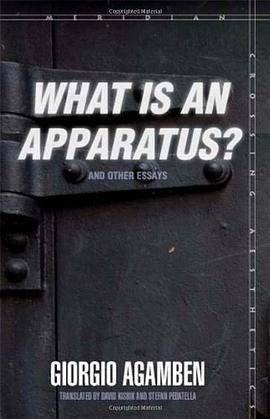
"What Is an Apparatus?" and Other Essays
内容简介
The three essays collected in this book offer a succinct introduction to Agamben's recent work through an investigation of Foucault's notion of the apparatus, a meditation on the intimate link of philosophy to friendship, and a reflection on contemporariness, or the singular relation one may have to one's own time.
"Apparatus" (dispositif in French) is at once a most ubiquitous and nebulous concept in Foucault's later thought. In a text bearing the same name ("What is a dispositif?") Deleuze managed to contribute its mystification, but Agamben's leading essay illuminates the notion: "I will call an apparatus," he writes, "literally anything that has in some way the capacity to capture, orient, determine, intercept, model, control, or secure the gestures, behaviors, opinions, or discourses of living beings." Seen from this perspective, Agamben's work, like Foucault's, may be described as the identification and investigation of apparatuses, together with incessant attempts to find new ways to dismantle them.
Though philosophy contains the notion of philos, or friend, in its very name, philosophers tend to be very skeptical about friendship. In his second essay, Agamben tries to dispel this skepticism by showing that at the heart of friendship and philosophy, but also at the core of politics, lies the same experience: the shared sensation of being.
Guided by the question, "What does it mean to be contemporary?" Agamben begins the third essay with a reading of Nietzsche's philosophy and Mandelstam's poetry, proceeding from these to an exploration of such diverse fields as fashion, neurophysiology, messianism and astrophysics.
......(更多)
作者简介
Giorgio Agamben, a leading Italian philosopher and radical political theorist, is Professor of Philosophy at the University of Venice. Stanford University Press has published six of his previous books: Homo Sacer (1998), Potentialities (1999), The Man Without Content (1999), The End of the Poem (1999), The Open (2004), and The Time that Remains (2005).
......(更多)
目录
......(更多)
读书文摘
部署 (dispositif) 这个词,或者说英文的 “装置”,在福柯的思想策略中是一个决定性的技术术语。他经常使用这个术语,尤其是从十九世纪七十年代开始,当他开始集中关注他所谓的 “治理术(governmentality)” 或“人的治理 (government of men)” 的时候
a. 装置是一种同质性的集合 / 设定,它事实上在同一个头衔下包括一切事物,无论是语言的还是非语言的:话语,制度,建筑,法律,警务措施,哲学命题,等等。装置本身是在这些要素间确立的网络。 b. 装置总是具备某种具体的策略功能,并总是坐落在某种权力关系之中。 c. 如此,装置,看起来就是权力关系与知识关系的交点
......(更多)